

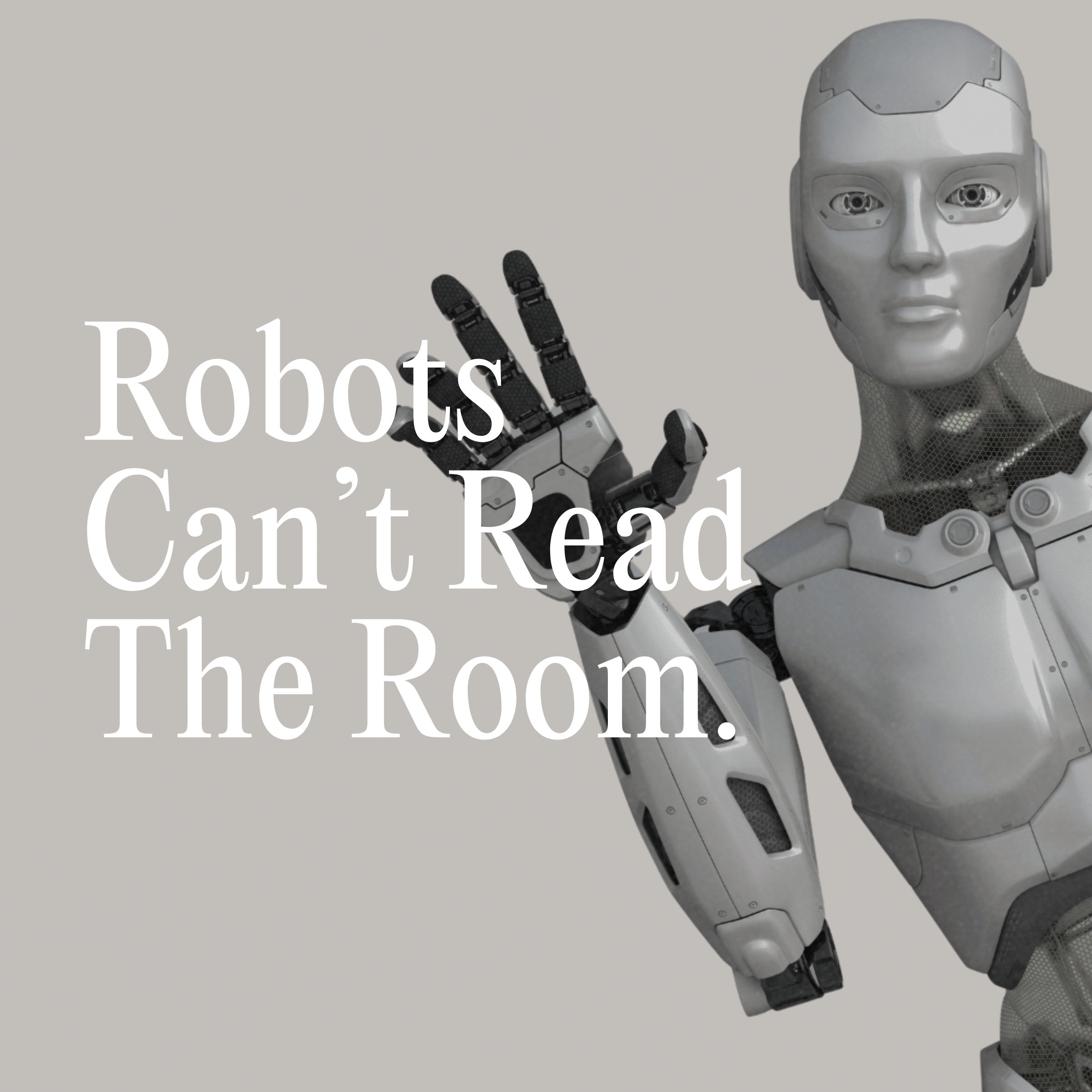
AI Is Automating Everything—Except Empathy
“When you take this job, just know—you’re joining an industry with a lot of feelings.”
That was the warning I got when I left Nike and took a role at a healthcare startup owned by Providence. After years in a high-performance, highly competitive culture—one that at times felt like Game of Thrones—I knew I was stepping into a very different world.
At Providence, care replaced competition. My leadership team was made up entirely of women from the nonprofit sector. It was a deliberate shift, and it forced me to grow in new ways—especially in one area I hadn’t been asked to flex at Nike: soft skills.
What I didn’t realize back then was that this wasn’t just a personal pivot. It was a preview of where work—and leadership—is headed.
From Creator to Connector
We’ve watched the creator economy explode. What started as influencers doing brand deals has grown into a $250 billion ecosystem. Creators now launch product lines, build media empires, and shape the cultural conversation.
But the creators who succeed today? It’s not just because they have better lighting or slicker edits.
It’s because they know how to connect.
The real power isn’t in content—it’s in connection. The ones who win are deeply tuned in. They read the room. They pivot when it matters. They show empathy. They build trust. That’s emotional intelligence in action—and it’s their biggest edge.
And it’s not just creators. At Goodstory, we’ve seen this transformation across industries. In fact, according to LinkedIn, human-centric skills like empathy, adaptability, and trust-building are now growing in importance across every industry. Since 2018, roles that once downplayed these traits have increased their emphasis on them by 20%.
The more we rely on AI to do the thinking, the more valuable human feeling becomes.
In many ways, the creator economy gave us a preview: the people with the most influence aren’t the loudest, they’re the most tuned in. They lead with intuition, not just information.
And the stakes are only growing. Goldman Sachs now values the creator economy at over $250 billion—and expects it to nearly double to $480 billion by 2027.
Welcome to the Connection Economy
What started with creators is now reshaping the entire workforce.
By 2030, 70% of the skills used in today’s jobs will have shifted—driven in large part by AI.
No, robots aren’t replacing all of us. But we have spent the past decade rewarding speed, scale, and technical mastery. As machines take on more of that, it begs the question:
What’s left for us?
The answer is connection. Human connection.
The next era of work—of marketing, leadership, creativity—will belong to those who can inspire, resonate, and relate. You can still call them “soft skills,” but the ROI is anything but soft.
And it’s not just about external audiences anymore. Emotional intelligence will determine who leads through uncertainty. Who builds loyalty. Who people actually want to follow. Inside organizations, it will decide who earns trust—and who gets left behind.
The Tools Are Getting Smarter. So Must We.
Yes, AI is getting better—fast. Tools like ChatGPT, Midjourney, and ElevenLabs can write, design, and even mimic human tone. But here’s what they can’t do:
- Understand cultural nuance
- Recognize trauma
- Nail timing in a sensitive conversation
- Know when not to speak
- Make someone feel seen
But as we discuss in AI:The Human Edge in an Automated World, they’ll never replace genuine human connection. They’ll never fully understand nuance, context, culture, trauma, or timing. They haven’t lived it. They’re not human.
And that’s what people are craving more than ever—not polish. Not perfection. Just something real.
The New Reality of Work
As AI takes over tasks, emotional intelligence is fast becoming the most sought-after skill in the global workforce.
The World Economic Forum ranks it among the top 10 skills of the future. Since 2022, LinkedIn has seen a 140% increase in members adding both AI skills and human-centric capabilities like communication and leadership.
Why? Because technical talent alone isn’t enough anymore.
Microsoft cut 1,000+ jobs in Azure. Meta laid off 3,600 workers. Stripe let go of 300 more. These weren’t underperformers. They were solid engineers and data scientists—made obsolete by automation.
These weren’t underperformers. They were technically strong employees—but their roles were purely executional. And that’s exactly where AI is accelerating the fastest.
Even tech CEOs aren’t pretending otherwise. Zuckerberg openly said AI will replace many mid-level engineers. Google’s CEO shared that AI already writes 25% of their new code.
The lesson? Technical skill alone won’t be enough. The edge will come from what machines can’t replicate: judgment, empathy, creativity, and leadership.
So if AI can code better and faster… what can’t it do?
It can’t lead with empathy.It can’t sense when your team is off. It can’t ask the question no one else is asking. It can’t build trust.
Emotional Intelligence, Defined
Emotional intelligence (EQ) isn’t about being agreeable. It’s about navigating emotion—yours and others’—to build stronger outcomes. You can spot it in someone who:
- Listens more than they talk
- Responds to criticism without defensiveness
- Adjusts their tone based on who’s in the room
- Leans into conflict with empathy
- Makes others feel heard and understood
- Balances conviction with humility
These aren’t “nice to haves.” They’re what effective leadership looks like in an AI-enabled world.
What Will Actually Make You Irreplaceable
Let’s be clear: You won’t be replaced by AI.But you might be replaced by someone who knows how to work with it—and still lead like a human.
The most valuable people in tomorrow’s workforce will be those who can:
- Spot when AI gets it wrong
- Know when to override the algorithm
- Lead with empathy
- Connect with people in ways machines never will
In my article Why the Best Marketers Think Like Leaders, Not Technicians, I explore how today’s top performers blend technical know-how with EQ.
It’s not just about what you know. It’s about how you show up.
You’ll win roles not just because you’re skilled, but because:
- You read the room
- You listened with intention
- You brought people along
- You made them feel like it was their win
And trust me—people remember how you made them feel.
What Machines Can’t Touch
AI exists to serve human interests—but it will never be human.
Amazon has spent billions perfecting its recommendation engine, but it still can’t replicate the moment a friend hands you a book and says, “You have to read this.”
It can help doctors diagnose, but it can’t offer comfort when someone hears hard news.
It can spit out a script—but it can’t know when to shut the laptop and say, “Are you okay?”
Let’s End Here
“We’re going to have to have, I think, a little bit more of a central role for human dignity…or as we develop these computers we’ve taught to mimic people, things are going to get very unruly and unkind.”—Ezra Klein
We’re not being replaced. We’re being called to show up more human than ever before. More intuitive. More connected. More emotionally intelligent.
This is what Gina Clementi and the team at Goodstory champion every day—helping brands and leaders show up with meaning, not just messaging.
Because in the end, meaning is the one thing no machine will ever master.
Want to Know More?
If this piece resonated with you—or if you’re navigating how to lead with empathy in an AI-driven world—let’s talk.
At Goodstory, we help teams and leaders like you turn human insights into real-world impact.
Contact Gina Clementi to explore how we can support your brand, your leadership, or your next bold story.


